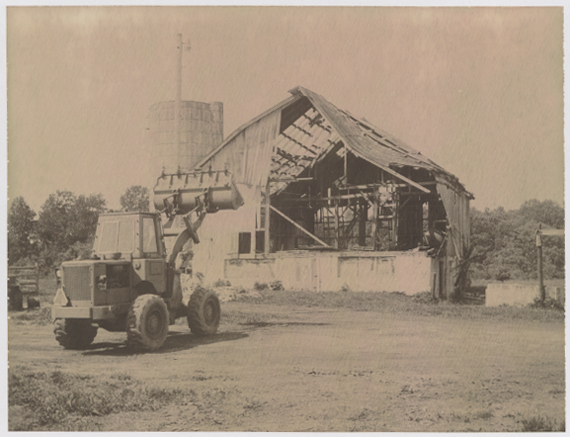
 Farm
Holga 120S
Kodak T-Max 400 Photomerge
Bear, DE / February 18, 2011
Sizes and Pricing
To be added.
15% of all sales will be donated to Preservation Delaware.
Printing and framing by Colourworks.
FarmHolga 120S
Kodak T-Max 400 Photomerge
Bear, DE / February 18, 2011
To be added.
15% of all sales will be donated to Preservation Delaware.
Printing and framing by Colourworks.
 Produce
Polaroid 250 Land Camera
Polaroid 100 Chocolate Giambarba Expired
Bear, DE / Fog / April 20, 2011
Polaroid 250 Land Camera
Expired Polaroid 100 Chocolate Giambarba Peel Apart Film
Enlarged and printed on
Hahnemühle William Turner 310 gsm paper
Float Mount
Limited Signed Edition of 10 Float Mount*
24″ x 19.5″
Edition 1 – 4: $425
Edition 5 – 8: $500
Edition 9: $625
Edition 10: Held by the artist
Unmounted signed 24″ x 19.5″ prints: $100
Unmounted signed 10″ x 8″ prints: $40
The only editing done on the photo was dust removal using Photoshop CS5. All colors match the original Polaroid.
15% of all proceeds will be donated to Preservation Delaware.
Printing and mounting by Colourworks.
* Why float mount instead of frame? Float mounts were chosen to showcase an enlarged
version of the Polaroid image, as if the Polaroid itself was mounted on the wall.
Float mounts are archival, museum quality, and hang with traditional wall hooks.
A floated image mounts on the wall beautifully, especially when the image is a Polaroid:


On Saturday, May 21, 2011, beginning at 3:00 in the afternoon, the barn at 2335 McCoy Road was razed. This is part 1 in a 2 part post about the razing and details the events photographed with my Polaroid 250 Land Camera using Polaroid 100 Chocolate Giambarba Expired (10/2009 if I’m correct).
Construction Unlimited, the owners of the barn and the property around it, had been planning on razing the barn for weeks. But, delays and then a week of rain had out it off. Finally, the day was set. Unfortunately, they decided the barn would be razed in the afternoon, which meant that all the gorgeous morning light that hits the eastern facing front of the barn would be lost. I had no idea, really, how the Polaroid 250 and Chocolate film would handle the strong sunlight. At 2:30, after a morning of putting together new deck furniture, I hurried over to the barn to see what was going on. They were just getting started attaching a rope to one of the inner rafters. The rope would then be attached to a bulldozer. I quickly set up two cameras, the Polaroid 250 and my Nikon D90, on two tripods and the Flip video camera on a third tripod. Thankfully they decided to start by pulling the rafter in to the south which meant that the sunlight was slightly behind me and I would also set up the cameras in the share of a tree. Anticipating a dramatic crash at any moment, I have way too many photos that look something like the below image. I chose this one because it seems like the earth mover is in the process of bowing in deference to the barn. And, indeed, the barn won this round: the rope snapped in half without the barn even budging (Barn 1 – Machine 0).
We then shifted to the eastern face of the barn. I started to become much more conservative in pressing the shutter, especially because they tied the rope to some metal dangling off the wall (if you look closely just below center you can see the rope draping into the grass). The result: the metal was pulled off; the barn didn’t budge (Barn 2 – Machine 0).

Next, they sent an employee to get some chains and we switched back to the southern face. While waiting for the chains, they thought that attacking the barn with the earth mover would work. They splintered off a (massive) beam (Barn 3 – Machine 0).

With the chains attached, the barn started to lose ground—though the earth mover struggled. It was incredible to watch 200+ year old construction resist the earth mover—especially because we knew the new construction across the street would have toppled with just the rope attached. It was also, quite sad (Barn 3 – Machine 1).


We then shifted to the north face and it was here that I got quite worried about the photos. I was now facing into the sun and I had no idea how the Polaroid 250 would handle it. Worried the photo would be completely blown out, I made a slight adjustment on the brightness wheel to darker. I’m pleased with the darker colors and really likethe lens flare in the bottom left corner. After some planning, they attached the chains to the north-east support beam (Barn 3 – Machine 2):


The moment the barn fell with great destruction was completely chaotic. I had just set up the cameras in a new location so I could get the barn and the earth mover in the frame. I was still getting ready when all of a sudden the earth mover was moving. I was cocking the level, snapping the shutter, pulling the paper, and pulling the photo through the rollers in a frenzy, while simultaneously trying to hold the shutter down on the D90 (my wireless remote shutter was not working—must get wired one immediately). This photo, which has an unfortunate dark area, succinctly captures the chaos. It is slightly out of focus, has tons of movement, and may even be a double exposure (if possible on the 250) (Barn 3 – Machine 3):

And here, the final shot in that pack of film, is the barn partially razed. When in the field I usually peel the goopy border off the photo immediately, but I knew it was my last shot so I decided to keep it on:

In Part 2 of this series, I will detail the rest of the razing as documented with my Canon AE-1.