
Retention Pond 4
Sunday, January 13, 2013
Fog, 45 degrees
Polaroid 250 Land Camera
Polaroid 100 Chocolate Giambarba Expired 2009
Wrangle Hill Rd at Oakwood Blvd, Bear, DE

Retention Pond 4
Sunday, January 13, 2013
Fog, 45 degrees
Polaroid 250 Land Camera
Polaroid 100 Chocolate Giambarba Expired 2009
Wrangle Hill Rd at Oakwood Blvd, Bear, DE


Duck Creek in Fog
Sunday, January 13, 2013
Fog, 45 degrees
Polaroid 250 Land Camera
Polaroid 100 Chocolate Giambarba Expired 2009
Duck Creek from the southbound shoulder of
South DuPont Highway, Smyrna, DE


Red Lion Creek in Fog
Sunday, May 21, 2013
Fog, 65 degrees
Polaroid 250 Land Camera
Polaroid 100 Chocolate Giambarba Expired 2009
Red Lion Creek from the northbound shoulder
of South DuPont Highway, Bear, DE


The Appoquinimink in Fog
Sunday, December 2, 2012
Fog, 43 degrees
Polaroid 250 Land Camera
Polaroid 100 Chocolate Giambarba Expired 2009
The Appoquinimink River from
Route 13 Northbound, Odessa, DE


Lums Pond in Fog 4
Sunday, March 18, 2012
Fog, 50 degrees
Polaroid 250 Land Camera
Polaroid 100 Chocolate Giambarba Expired 2009
from the Swamp Forest Trail,
Lums Pond State Park, Bear, DE


Nine Canada Geese Over Taylor’s Gut
Sunday, December 2, 2012
Fog, 45 degrees
Polaroid 250 Land Camera
Polaroid 100 Chocolate Giambarba Expired 2009
from a birding platform in
Woodland Beach Wildlife Area, Smyrna, DE


Duck Creek River Marsh
Sunday, January 13, 2013
Fog, 45 degrees
Polaroid 250 Land Camera
Polaroid 100 Chocolate Giambarba Expired 2009
from Woodland Beach Road in the marshes of
Duck Creek River, Smyrna, DE
This has been a week of waiting and disappointments. The weather has predicted thunderstorms with 70-80% chance of precipitation all week. A gift of a week for someone who wants to photograph in the rain. And, yet, every day that Wendy has been home from work (so she can watch Hydan when I go out to photograph), the clouds would roll in, and as I watched them approach Bear, DE, on weather.com a giant hole would form right over Bear. Rain to the north, south, east, and west. Twice I drove out and sat in the back of my Prius, hatch open, back seats down, camera on tripod pointing at the barn at 2335 McCoy when the weather said 100% chance of rain. Maybe a drizzle for 5 minutes. Yesterday when the rain didn’t come I spent an hour or so testing new Impossible Project film.
So, today, after so much disappointment and curses to the rain gods, I didn’t even think about photographing the barn in the rain. I got up, scanned in my images from yesterday’s shoot, ate breakfast with Wendy, composed a long blog post, ate lunch with Wendy, and then went outside to work on the raised bed garden we’re making. Not 10 minutes in to the gardening and I hear thunder. What a tease, I thought. Then a bit of lightening and some more thunder. I looked at the weather app on my iPhone and lo and behold another storm approaching.
Because I hadn’t been thinking about it, I wasn’t prepared, so I ran—covered in mud, I must say, from the gardening—to get my cameras, tripods, and film, and hurried over to 2335 McCoy. I parked the car, opened the hatch, and started setting up the cameras. I still had Polaroid 100 Chocolate Giambarba Expired in the 250 Land Camera, which I was planning on using. But where was the other pack? And the Polaroid 644 Twin Giambarba Expired pack? I called Wendy. I left it sitting in the garage. The rain was starting. While she packed Hydan into the car and drove the film over, I took a meter reading and loaded a Holga with 100 speed film and taped it with gaffer’s tape. Wendy arrived with the film just as the rain was getting going. The sky darkened. Wendy left. I took another reading. Damn! I loaded my other Holga with 400 speed film and wrapped it with gaffer’s tape. I set up the travel tripod with the 250 Land Camera, got in the hatch, and waited for the real rains to come. As the rain got heavier I made a few images with the 250 Land Camera and was so frantic to not miss the full storm I forgot that I had one last picture left in the pack when I opened it to load another pack of Chocolate. (I did, however, pause and check to make sure the rollers were clean.) Still heavy rain, but not the real downpour I knew I would need if I were to capture any rain and water running off the roof with the Chocolate film. So, I grabbed the Holga with the 400 film, set it on Cloudy, and rain out into the rain. I must have looked like a maniac to the contractors working on other buildings on the lot. It was my Holga waist level modified by Randy at Holgamods and has a UV filter attached to it, so the filter was getting very wet. I, in just shorts, t-shirt, and baseball cap, was drenched, as well. But, I convinced myself that rubbing my wet shirt on the filter would get enough drops off of it to make a good photo. Midway through, however, winding got very difficult. Then extremely difficult. (I knew something was very wrong and when I opened it later I saw that the film had for some reason rolled at an angle and was crunched and loose on the spool. I hid it in darkness and then wrapped it in aluminum foil. We’ll see how that turns out.) But, when all 12 shots were taken, I got back to the car and a minute later the skies really opened up. I got the 250 Land Camera in front of me, dried it off a bit, and was able to take one photograph before the torrent slowed. And, I tell ya, getting all soggied was well worth it, as the photo captured the rain and water running off the roof—the one thing I really wanted:

It may be hard to see here, but I just printed a version of the image on 13 x 19 paper and, wow, it looks great. Here are before, during, and after images:


All my equipment survived intact and none of the film got wet. So, all in all a great experience.
Since the barn at 2335 McCoy Road was not knocked down two weeks ago as had been planned (demolition is now scheduled for this coming weekend) I took the opportunity to try out two Impossible Project films: PX 600 Silver Shade version 06, which came in a twin pack with the Dry Age Kit, and PX 100 Silver Shade

The PX 600 is being used in a Polaroid Impulse AF that belonged to my paternal grandmother, Toby Wolff, who passed away two years ago at the age of 99 and 1/2. She was an avid Polaroid user and I’m so happy to have her last Polaroid camera, hard black Polaroid case, and many Polaroid photos that she took of the family. The other camera is a Polaroid Pronto! S that belonged to my maternal grandparents, Maurie and Harriet White, who are both in their 90s and still living. The Pronto! was in my grandfather’s camera bag that he gave to me a few years ago along with a Canon AE-1 and a Canon A1 Program. I had no idea that he had the Polaroid and I was happy to find it in a soft beige Polaroid case with the user’s manual and a flash bar.
Because the Impulse AF has a tripod mount, it and PX 600 were the first to be tested. It was May 9, 2011, and though I had read about the film’s sensitivity to temperature, that it has to be used between 63 and 77 degrees, I was brazen and brought it out on a crisp, cool, color-saturated morning in the upper 50s, while I was photographing the barn with Fuji 100 color peel apart film on my Polaroid 150 Land camera. The results:

Developed in the shade at around 60 degrees F.

Developed in the sun at around 60 degrees F.
I knew after seeing these images that the temperature was the most likely culprit, but I was worried about the vertical striations in the second image. So I could be sure that the camera wasn’t broken, I took a photo of my wife feeding my son some organic applesauce. The interior temperature was around 72 degrees F. I was relieved and, in fact, amazed by the color shades and crispness in the result:

Before heading out to test the film again, I went back to the The Impossible Project’s PX film optimization page and found The Mijonju Show’s video, “Tricky PX100 films,” which led me to The Mijonju Show’s “PX100 Side by side temperature experiment.” It shows very well how sensitive PX film is to temperature:
After seeing the video I suspected that the striations were the result of me not covering the image fast enough. As a result, using gaffer’s tape I dangled part of a Polaroid Chocolate film box from the front of the camera so when the image would come out the Impulse it would be covered.
On the evening of May 12, 2011, when it was about 72 degrees outside with a bright sunset, I went for my second test of the 600 film. A sample of the results:


Though I was very happy the images were appearing with more consistency, and the darker tones suggested I was covering the images better as I got used to the process, I wasn’t pleased that the striations were still appearing. The third photo also looked like it has some lens flare in the center right. The only thing I thought that could be causing the striations and lens flare was that the ever so brief moment that the sun hit the image as it came out of the camera. If I had realized this sooner I would have taken my umbrella out of the car and used it as a lens shade, but, alas I didn’t.
Yesterday evening, May 19, 2011, with thick clouds overhead and a nice 68 degrees F, I tried again. Instead of using my hand to cover the film as I moved it from the camera to the Tupperware container I was using to hold the film as it developed, I used an inverted and then folded up a box that once held Polaroid 664 Twin Giambarba Expired film. As soon as the photo was out of the camera and under the cardboard flap that was dangling from the camera, with my left hand I slid the image out and under the folded box. I then rushed the photo to the Tupperware container (which, I must add, I wrapped with black Gaffer’s take so no light would get in through the bottom and sides). I also used the folded box to keep the dangling cardboard down and put pressure on one side of it so light couldn’t get in from the side; the other side I covered with my left hand immediately after pressing the shutter. Here are the results in the order the images were taken:


 I attempted to make a duplicate of this image because I wasn’t happy with the how the right corner of the roof blurred and went out of the frame in the first photo. I was, however, careless and my hand slipped as the film came out of the camera. The result is the vertical striation. Interestingly, my wife likes this one better.


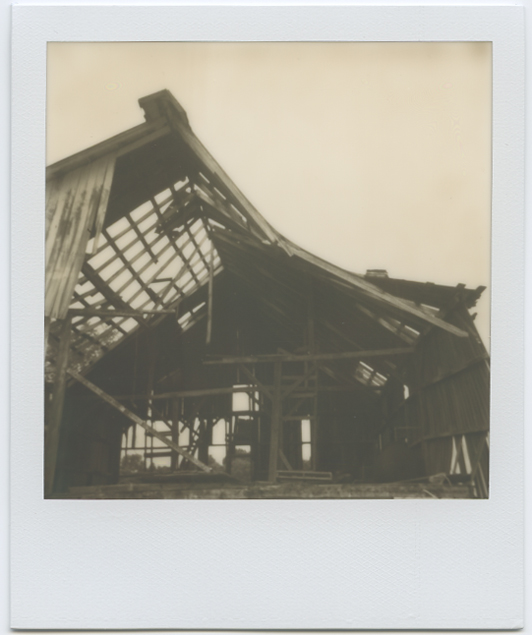
I also still blown away by the level of detail in these photos, especially considering the camera is so old and hadn’t been used for at least a decade. I particularly love the depth of the detail in, for example, 4th and 6th photos. In the 4th, the inner door and trees beyond are very clear even at this low resolution scan. In the 6th, through the inner window we can see the straps that wrap around a silo. The tones and shades are also quite impressive and compliment quite well the subject. Most gratifying, however, is working through making an effective image with new film and a new camera. Using a Polaroid is like working a complex puzzle (just like using toy cameras). There are so many factors involved in order to make an effective image beyond those that go into traditional composition. Thinking about the weather and the temperature. Calculating development times. Crafting little tools to help the image develop properly (we also see this using the Holga when I add portions of folded film boxes to ensure the film is taught and by wrapping the seams in gaffer’s tape). This is the joy of photographing with instant film and toy cameras.

And, there is never any end to the puzzles that one is confronted with. For example, consider the Polaroid Pronto! S. First challenge: there is no tripod mount. A little gaffer’s tape and whallah: a Pronto! attached quite soundly to my travel tripod (note the cardboard dangling from the front, as well):

Here are the photos made with the Pronto and PX 100 Silver Shade Film, taken at the exact same time as the above PX 600 successful images, in the order they were recorded:
 I suspect the dust is a result of dirty rollers, which I carelessly forgot to clean. The striations are as a result of not perfecting the process of covering the image as it comes out of the camera.
 Here, more dust and some spots to the left. Not sure why those appear.
 It’s hard to tell on my screen, but the black areas in this image have turned red. I like the effect and wish I knew why it was happening so it could be replicated. The image could be a bit darker.
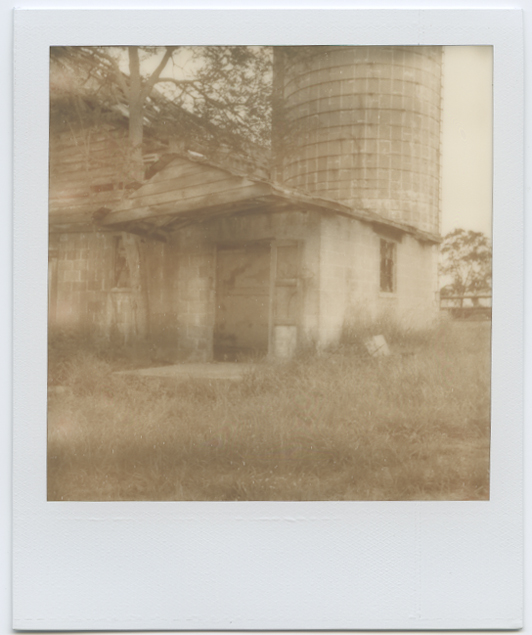 Again, some blotches on the left edge. Perhaps a light leak?
 Striations and blotches, the former a result of my hand slipping.
So, lot’s to figure out with the Pronto!—though, my wife really likes these images. “They have an old feel to them,” she says. I didn’t use all the film because it was getting too dark and I was getting hungry. I’ll need to buy some new film and Dry Kits, though, because I totally love this film. It’s too bad I didn’t start using it early because these will be the only images of the barn before it is razed this weekend.
On Wednesday, April, 20, 2011, I woke up and looked at the weather app on my iPhone (as I do every morning) and saw that it was foggy out. I had been waiting for a foggy day to get out early and take photos of the barn and landscape at 2335 McCoy Road in the fog. I leaped out of bed opened the blinds and, eureka, fog! I put Hydan in the cars eat and rushed out of the house to take some photos with a role from my new batch of Polaroid 100 Chocolate Giambarba Expired. The results were both surreal and unexpected. The Chocolate film is supposed to have a sepia tone to it, as in my other Chocolate Polaroid photos. Not this time it seems. The brownish tint is hinted at in the foreground, but the background and sky are a shade of pink. The pink got pinker as the images dried and the dark foregrounds got darker. I’m not sure if this is because the film sat out of the fridge for a week while we were in Boston or if its just a a symptom of the expired film or somehow due to the foggy conditions. Either way, I really enjoy how the fog makes the barn and the distant woods somewhat ephemeral and ghostly.


Below are 9 of 10 contact sheets from several March 2011 photo shoots of the barn, house, other buildings, and surrounding land at 2335 McCoy Road. The 10th sheet is too long to fit in the scanner (more on that later). Please ignore the poor quality of the scans; they were scanned in color on a HP all in one printer with a feeder that allows for quick, but poor quality scans.
These sheets contain photos taken with six different cameras. I couldn’t be more pleased with the results. They make me wonder why I would ever shoot digital again.
 Canon AE-1 with Fuji 100 Acros film, wide angle and zoom lenses
I thought there had been something wrong with this camera but it turned out that I had two bad batteries in a row. Very happy to be back using it. Love this camera.
 Kodak Target Six-Twenty Box Camera with Kodak 400-TMY on 620 rolls
This roll and the below are the first photos I’ve taken with this box camera (or any box camera for that matter). This is a new favorite.
 Kodak Target Six-Twenty Box Camera with Kodak 400-TMY on 620 rolls
 Holga 120s with Kodak 400-TMY
The top two rows will be made into a composite image. Not really sure what happened with the bottom row.
 Holga 120WPC Wide Angle Pinhole with Kodak 400-TMY
The below contact is a rescan of the vertical shot that is too light above.

 Holga 120WPC Wide Angle Pinhole with Kodak Extar 100
 Eastar 120 Twin Lens Reflex with Fuji Pro 400H
 Happi Time Camera with Kodak Portra 160NC on 127 Rolls
I’m just happy that any images came out. I had to tape the camera to the tripod and I wasn’t completely sure the shutter was working. Either I screwed up every other photo or I have twice the number of images per roll.
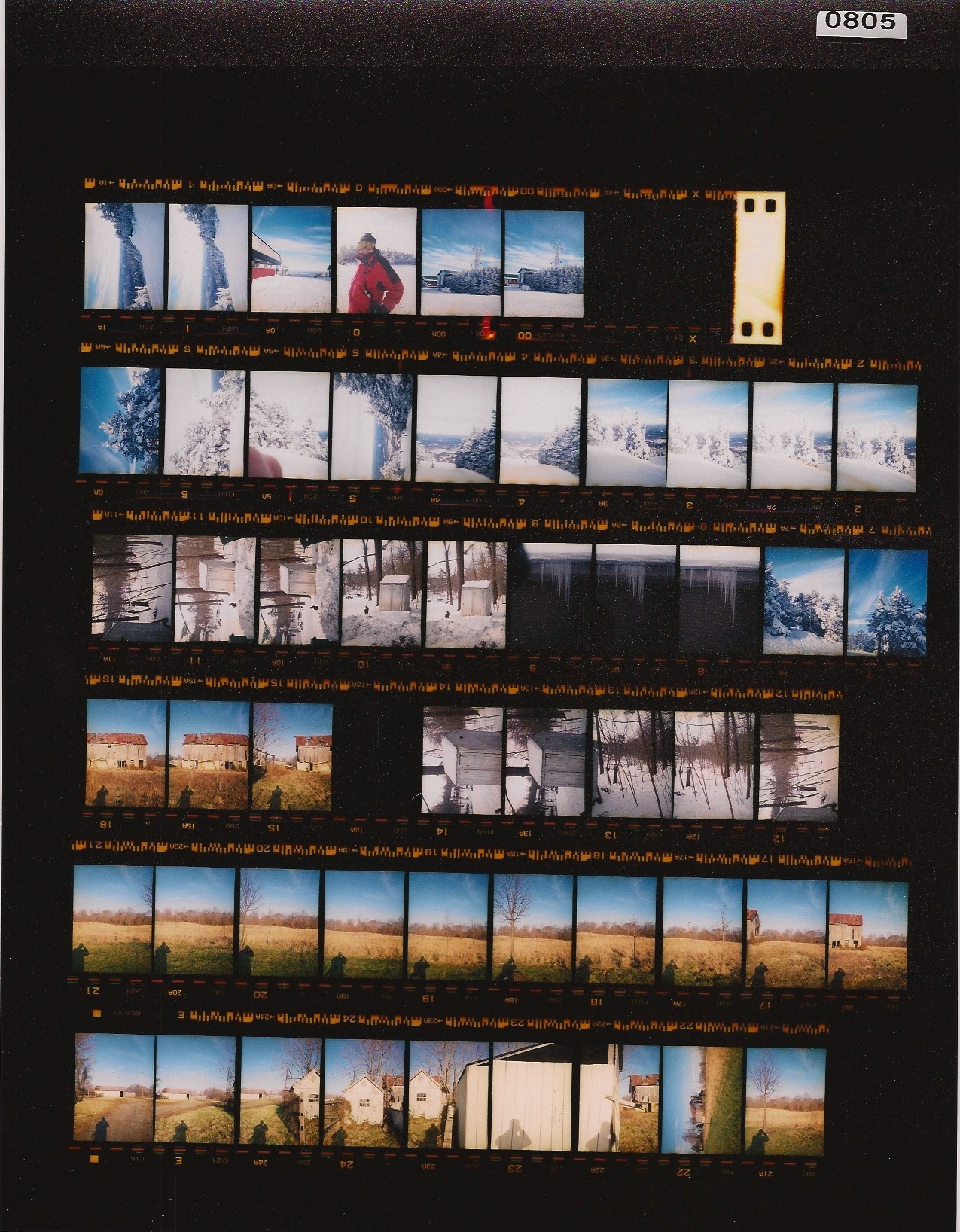
Golden Half Camera with Fuji 200
The winter images are from a January Ski trip to Stratton, VT.

 Like thousands of others, last night I braved the chilly temperatures to photograph the first winter solstice lunar eclipse since 1638 and the last during my lifetime. I recently took an online photography class on night photography with the stunning photographer (and great teacher) Kent Weakley where I learned about photographing the moon, among other things. I was excited to get out there and apply what I’d learned.
This kind of activity really exposes weaknesses in lenses and though my Panasonic DMC-FZ50 is a good camera, a higher quality DSLR with an exceptional lens would have been wonderful to have last night. Still, I’m quite pleased with how many of the images came out. Here are some of the better ones in a sequence of six (click on the image to get the full resolution):

The first four images were taken with the Tungsten filter applied. This is what gives the blue-gray tint. The fifth image was shot with the daylight filter and the last image with the Shady setting applied. This enhanced the red glow. I wish I had shot the latter two with Tungsten, as well, but what can you do.
Here is the sequence again with the image information (click image for full resolution):

Unfortunately, my photos of the eclipse when it was at its greatest (3:17am) didn’t come out. I wish I had known about Bob Atkins’ excellent discussion of lunar eclipse photography prior to starting to shoot the photos. Mine suffer from f-stops that are either too wide or not wide enough and exposures that are too long.
Because the night was so clear, however, I did get a chance to take some photos of the starts, especially Orion, which I have long loved to gaze at. (Ironically, back in college I wrote a poem that included a lunar eclipse and “Orion’s belt pointed at the shadowed moon.” If I can find it I’ll post some lines that relate.) Here are a couple:
 Orion and the Little Dipper
Panasonic DMC-FZ50
Tiffen 55mm UV Filter, Shady Setting
ISO 200; F/2.8; 25 seconds; 7.4mm
 Orion and the Little Dipper in Tungsten
Panasonic DMC-FZ50
Tiffen 55mm UV Filter, Tungsten Setting
ISO 200; F/2.8; 30 seconds; 7.4mm
All in all, a fun evening on the back deck. Totally worth staying up until 4:00am.

 December 2010 Lunar Eclipse Sequence
Panasonic DMC-FZ50
(click photo for larger image)
 December 2010 Lunar Eclipse Sequence with Image Info
Panasonic DMC-FZ50
(click photo for larger image)

 Decaying Barn
Panasonic DMC-FZ50 with Tiffen 55mm UV Filter
ISO 100; F/5.6; 1/400; 35mm
Bear, DE / 2009
Framed Limited Signed Edition (one of twenty): $250 + shipping
Unframed: $100 + shipping
All giclée fine art prints are on Hahnemühle FineArt smooth paper.
Framed prints are 23″ x 19″ (16″ x 12″ print, 3″ four-ply archival white matte, and 1″ black wooden frame).
Unframed prints are 16″ x 12″.
15% of all sales will be donated to The National Trust for Historic Preservation.
Printing and framing by Colourworks.

 Cherry Trunk
Holga 120S Modified with Waist-level Viewfinder with Fuji ProH 120 film
ISO 400; Sunny; One Person
Wilmington, DE / 2010
Framed Limited Signed Edition (one of twenty): $200 + shipping
Unframed: $85 + shipping
All giclée fine art prints are on Hahnemühle FineArt smooth paper.
Framed prints are 19″ x 19″ (12″ x 12″ print, 3″ four-ply archival white matte, and 1″ black wooden frame).
Unframed prints are 12″ x 12″.
15% of all sales will be donated to The National Trust for Historic Preservation.
Printing and framing by Colourworks.

I’m currently enrolled in an online photography class with Kent Weakley about night photography and I’m really enjoying it. I’ve learned much more than I ever expected. We’ve had a few assignments, the first being to get out and shoot during the blue hour, and the second to shoot the moon. I missed the blue hour shoot the first night and though I was out ready and waiting, the moon was behind haze the second night, so I tried to combine both this evening. Here are some of the shots that I got, in order, with some explanation.
I was hoping the moon would have appeared nice and bright just to the left of the Ferris Wheel. No such luck:
 Ferris Wheel at Moonrise, Tungsten, Thursday Night
Panasonic DMC-FZ50
Tiffen 55mm UV Filter, Tungsten Setting
ISO 100; F/11; 1/25; 95mm
 The Hazy Moon at Moonrise, Wednesday Night
Panasonic DMC-FZ50
Tiffen 55mm UV Filter
ISO 100; F/11; 1/13; 199mm
 First Moon Shot, Thursday Night
Panasonic DMC-FZ50
Tiffen 55mm UV Filter
ISO 100; F/3.6; 1/25; 291mm
