
Lums Pond in Fog 4
Sunday, March 18, 2012
Fog, 50 degrees
Polaroid 250 Land Camera
Polaroid 100 Chocolate Giambarba Expired 2009
from the Swamp Forest Trail,
Lums Pond State Park, Bear, DE

Lums Pond in Fog 4
Sunday, March 18, 2012
Fog, 50 degrees
Polaroid 250 Land Camera
Polaroid 100 Chocolate Giambarba Expired 2009
from the Swamp Forest Trail,
Lums Pond State Park, Bear, DE


Nine Canada Geese Over Taylor’s Gut
Sunday, December 2, 2012
Fog, 45 degrees
Polaroid 250 Land Camera
Polaroid 100 Chocolate Giambarba Expired 2009
from a birding platform in
Woodland Beach Wildlife Area, Smyrna, DE


Duck Creek River Marsh
Sunday, January 13, 2013
Fog, 45 degrees
Polaroid 250 Land Camera
Polaroid 100 Chocolate Giambarba Expired 2009
from Woodland Beach Road in the marshes of
Duck Creek River, Smyrna, DE
The Basics
The Workshop: Creative Compositing: The Impressionistic Photograph
The School: Rocky Mountain School of Photography
The Instructor: Mark S. Johnson, Photoshop Guru and author of the beautiful and insightful Botanical Dreaming: Using Photoshop, Your Camera, and Your Heart to Create Inspiring Images
Assistant: Roxanne Duffy
Location: Boulder, Colorado
Dates: June 16 – 22, 2012
In Attendance: 12
Overview
For my 40th birthday this past January, my wife, Wendy, bought me a spot in the Rocky Mountain School of Photography’s workshop, Creative Compositing: The Impressionistic Photograph. Taught in Boulder, CO, by Mark S. Johnson, the workshop description reads:
If you are looking for a photographic experience to expand your vision and snap you out of your current way of seeing, this workshop is it. Through a combination of supportive photo evaluations and field shoots, Mark not only teaches macro photography, creative motion techniques and how to use multiple exposure, but he also rolls out the red carpet for you to explore your artistic side. Using Photoshop, he helps you to create impressionistic images that incorporate various montaging techniques, painterly effects, and HDR (high dynamic range). He fosters a supportive environment that encourages participants to help each other grow technically and creatively. Group critiques help bring into focus the lessons presented throughout the week and solidify your learning experience.
I suspect Wendy purchased this workshop because of the location (we both love Colorado and I’d never been to Boulder), the dates (I’m not teaching in the summer so I have time to spend away), and the description to “expand your vision” because I’m always trying to do that with my images. I also suspected that she might have picked up on the Impressionistic part of the title, as I have been working on an impressionistic series using Polaroid Chocolate film (and some in my Lum’s Pond series, as well).
I was, of course, very excited to receive such a wonderful gift, but I admit that I was a bit hesitant and more than a little nervous because most of my photography work lately has been with film. I also had no idea what “compositing” was and had what turned out to be uninformed ideas about HDR. Though I use Photoshop for touching up photos (mostly dust removal) and use some its other features, I’ve never been one who enjoys spending too much time there. My recent philosophy has been to record what I can through the viewfinder, avoid having to crop at all, and use Photoshop and Lightroom for only the most minor of edits that could have been accomplished in a darkroom, as well as dust removal. In that philosophy, Photoshop and Lightroom tend to be begrudgingly used accessories to the photographic process not a natural extension of the camera. Film photographers see (or, saw) the darkroom as the natural extension of the camera—the space where what was on the negative was made to appear on paper in a form that approximated as close as they could what they envisioned when pressing the shutter.
After completing the workshop, I understand how Photoshop and Lightroom (and Photomatix and the host of web sites that offer free textures and actions) can be considered in a similar way—and not just because of the phrase “digital darkroom” (which wasn’t used at all) but because digital photography affords different possibilities than does film, and Photoshop is a direct part of affording those possibilities. One makes creatively composited digital images with a mind toward post-processing in Photoshop. Recording the image in the DSLR is merely the first step in a long process of composing the image into something new.
The Instructor and the Course
To say that Mark Johnson is a wonderful instructor would putting it too lightly. He is , simply, incredible. His ability to recall the functions of Photoshop, Lightroom, Photomatix, and other applications was something to behold (and this is coming from someone who teaches instructional technologies at the college level). He has boundless energy and his enthusiasm for the creative processes that make up creative compositing was infectious. We all felt it and fed off of it. And even more importantly, he decided long ago that sharing his knowledge with those on the web—for free—was of utmost importance. I encourage anyone reading this to spend time on his web site and take in his Photoshop Workshop series, which has easy to understand video tutorials of just about everything you could ever want to know about Photoshop. They are free if you view them online and also available in DVD format. His book, Botanical Dreaming, which is part artwork, part macro photography technique, part inspiration, part life lesson, is 100% worth the cost, so I also recommend that to you. I’ve yet to read his other books, though I do have his HDR ebook.
This weekend the fog came in thick both mornings and stayed for hours (today until around 10:30). Wendy was off so I was able to get out with the Polaroid and make some photos in the fog. Now that the barn has been razed, I’m no longer photographing it, and I exhibited some images at Colourworks, I have decided to focus my attention on Lums Pond State Park for the time being. The reasons are many: it is beautiful during all seasons, it has an incredibly diverse ecosystem surrounding the pond, it is 5 minutes away, Wendy has a strong connection with it as she has been kayaking there for many years, and I really enjoy walking Hydan and riding (with Hydan soon) its many paths.
It’s been a while since I’ve taken out the Polaroid. Now that the Chocolate film is sold out on the Impossible Project web site (something I attribute to this video of a The Decemberists “Down by the Water” which, though I love the song, used 1000s of images) the film is extremely hard to come by and I’m getting stingy with the 30 packs I have left. I used 3 packs this weekend. The first pack (used Saturday) worked great up to image 6 and then mis-pulled and the rest got misaligned. The first pack on Sunday was a concern out of the box. Usually the packs have a nice amount of air in them. This one was as if it has been shrink-wrapped; no air at all. Sure enough, the black cover paper was very hard to pull out and the first tab broke off, as did the second, and third. Rather than fight it, I switched packs. The next pack worked perfectly (as most of them do), and because of my stinginess I passed-up many shots and there are two exposures left.
The conditions for the photos were essentially the same: morning, foggy, 50 or so degrees, and I developed the film for 55 seconds. They are all unedited. I’m starting to keep the paper attached to the images and on Saturday I had some goop issues. I didn’t have anything to wipe the goop off with. Sunday was much better as I had a paper towel. Still, the moisture in the air resulted in the images taking longer to dry, which let to a few sticking together.
The first four were made on Saturday, March 17, and the rest Sunday, March 18. You can also see them in my Lums Pond Flickr set. Enjoy!


These last two images teach me that I can get closer to subjects than the viewfinder suggests. A beauty of photography is that every shoot teaches me something.

 3 of 366
iPhone 4 Camera
Camera+ App with various effects edits
2 January 2012
One might wonder why the Y is in focus and the G out of focus.
After a day of grading 20+ essays, like I did today, I tend to feel G-like: a little out of focus myself, wondering why (Y) I spent the whole day inside (and not, say, out taking photos with my Polaroids).


1 of 366
Polaroid Spectra SE
Impossible Project PZ 680 Color Shade
1 January 2012
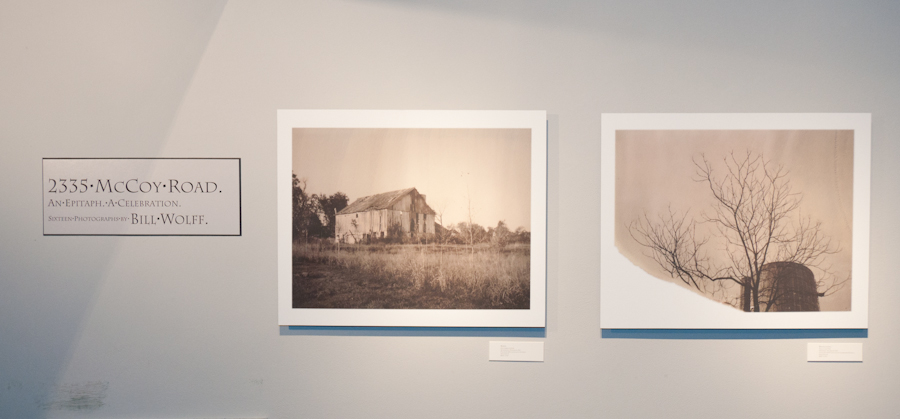
This month I have the great opportunity to have a photo show, “2335 McCoy Road. An Epitaph. A Celebration.” in the gallery space at Colourworks, the awesome Wilmington developing, printing, and framing shop run by Eric Russell and Gerry Piotrowski. Last night was the opening as part of Wilmington’s October first Friday Art on the Town and there was a great turnout of 50 – 60 people. Thanks to everyone who came out!
Here are some photos. The first is a panorama made with my iPhone. The others depict the images as you move around the gallery space from left to right:


Composing with Images Press, the press that I co-founded with Billie Hara, has released it’s latest call for entries. Take a look and consider submitting. If you have any questions, please let me know!

Composing with Images Press (CWiP) seeks images (photographs, drawings, or paintings), poetry, prose, and personal experiences (stories, letters, or journal entries) that explore and/or represent 5 different themes to create 5 different multi-genre books to benefit 5 charities. The charities and themes are:
The books created in response to this call will compose the first 5 books in our Student Books Series. In the Student Books Series students at colleges and universities under the guidance of their instructors and in collaboration with CWiP, will conceive of, design, and edit books to benefit a charity of their choosing. As with all CWiP books, 100% of the proceeds from book sales and submission fees will be donated to the students’ charity. The charities and themes for the first 5 books were selected by Writing Arts majors in Bill Wolff’s Writing, Research, and Technology course at Rowan University.
Deadline for submissions: October 17, 2011, at 11:59pm, Eastern Time.
Composing with Images Press is a small not-for-profit, all volunteer, independent book publisher founded by Bill Wolff and Billie Hara. CWiP publishes photo and art books that bring together image and text to engage creative, social, and cultural issues within a particular theme. 100% of all proceeds are donated to charity. Our first books were immediate best sellers and raised almost $1000 for BP oil spill cleanup efforts. Play!, a book to benefit The Marine Toys for Tots Foundation, will be released in November, 2011.
You will find a summary of each call below. Follow the links to the full call and submission specifics.
We look forward to your submissions! (more…)

 Barn
Polaroid 250 Land Camera
Polaroid 80 Chocolate Expired
Bear, DE / November 6, 2010
Polaroid 250 Land Camera
Expired Polaroid 80 Chocolate Peel Apart Film
Enlarged and printed on
Hahnemühle William Turner 310 gsm paper
Float Mount
Limited Signed Edition of 10 Float Mount*
24″ x 19.5″
Edition 1 – 4: $425
Edition 5 – 8: $500
Edition 9: $625
Edition 10: Held by the artist
Unmounted signed 24″ x 19.5″ prints: $100
Unmounted signed 10″ x 8″ prints: $40
The only editing done on the photo was dust removal using Photoshop CS5. All colors match the original Polaroid.
15% of all proceeds will be donated to Preservation Delaware.
Printing and mounting by Colourworks.
* Why float mount instead of frame? Float mounts were chosen to showcase an enlarged
version of the Polaroid image, as if the Polaroid itself was mounted on the wall.
Float mounts are archival, museum quality, and hang with traditional wall hooks.
A floated image mounts on the wall beautifully, especially when the image is a Polaroid:


 Farm
Holga 120S
Kodak T-Max 400 Photomerge
Bear, DE / February 18, 2011
To be added.
15% of all sales will be donated to Preservation Delaware.
Printing and framing by Colourworks.

 Woods
Holga 120S
Fuji Pro 400N Double Exposure
Bear, DE / February 18, 2011
Hahnemühle color paper
Box Mount
Limited Signed Edition of 10 Box Mount*
24″ x 24″
Edition 1: sold
Edition 2 – 4: $425
Edition 5 – 8: $600
Edition 9: $750
Edition 10: Held by the artist
Unmounted signed 24″ x 24″ prints: $100
Unmounted signed 10″ x 10″ prints: $40
The only editing done on the photo was dust removal using Photoshop CS5 and enhancing the corner vignette.
The photo is an in-camera double exposure.
15% of all proceeds will be donated to Preservation Delaware.
Printing and mounting by Colourworks.
* Why box mount instead of frame? A box mount was chosen to complement the Holga’s
corner vignetting and to extend visually the black borders.
Box mounts are archival, museum quality, and hang with traditional wall hooks.
A boxed image mounts on the wall beautifully, especially when the image is a Holga:

 Branching
Polaroid 250 Land Camera
Polaroid 100 Chocolate Giambarba Expired
Bear, DE / March 16, 2011
Polaroid 250 Land Camera
Expired Polaroid 100 Chocolate Giambarba Peel Apart Film
Enlarged and printed on
Hahnemühle William Turner 310 gsm paper
Float Mount
Limited Signed Edition of 10 Float Mount*
24″ x 19.5″
Edition 1 – 4: $425
Edition 5 – 8: $500
Edition 9: $625
Edition 10: Held by the artist
Unmounted signed 24″ x 19.5″ prints: $100
Unmounted signed 10″ x 8″ prints: $40
The only editing done on the photo was dust removal using Photoshop CS5. All colors match the original Polaroid.
15% of all sales will be donated to Preservation Delaware.
Printing and mounting by Colourworks.
* Why float mount instead of frame? Float mounts were chosen to showcase an enlarged
version of the Polaroid image, as if the Polaroid itself was mounted on the wall.
Float mounts are archival, museum quality, and hang with traditional wall hooks.
A floated image mounts on the wall beautifully, especially when the image is a Polaroid:
 Windows
Polaroid 250 Land Camera
Polaroid 100 Chocolate Giambarba Expired
Bear, DE / March 16, 2011
Polaroid 250 Land Camera
Expired Polaroid 100 Chocolate Giambarba Peel Apart Film
Enlarged and printed on
Hahnemühle William Turner 310 gsm paper
Float Mount
Limited Signed Edition of 10 Float Mount*
24″ x 19.5″
Edition 1 – 4: $425
Edition 5 – 8: $500
Edition 9: $625
Edition 10: Held by the artist
Unmounted signed 24″ x 19.5″ prints: $100
Unmounted signed 10″ x 8″ prints: $40
The only editing done on the photo was dust removal using Photoshop CS5. All colors match the original Polaroid.
15% of all proceeds will be donated to Preservation Delaware.
Printing and mounting by Colourworks.
* Why float mount instead of frame? Float mounts were chosen to showcase an enlarged
version of the Polaroid image, as if the Polaroid itself was mounted on the wall.
Float mounts are archival, museum quality, and hang with traditional wall hooks.
A floated image mounts on the wall beautifully, especially when the image is a Polaroid:
 Doorways
Kodak Brownie Target Six-20 Box Camera
Kodak T-Max 400
Bear, DE / March, 2011
To be added.
15% of all sales will be donated to Preservation Delaware.
Printing and framing by Colourworks.
 Silo
Canon AE1 with 24mm lens and yellow filter
Fuji Acros 100
Bear, DE / March, 2011
To be added.
15% of all sales will be donated to Preservation Delaware.
Printing and framing by Colourworks.